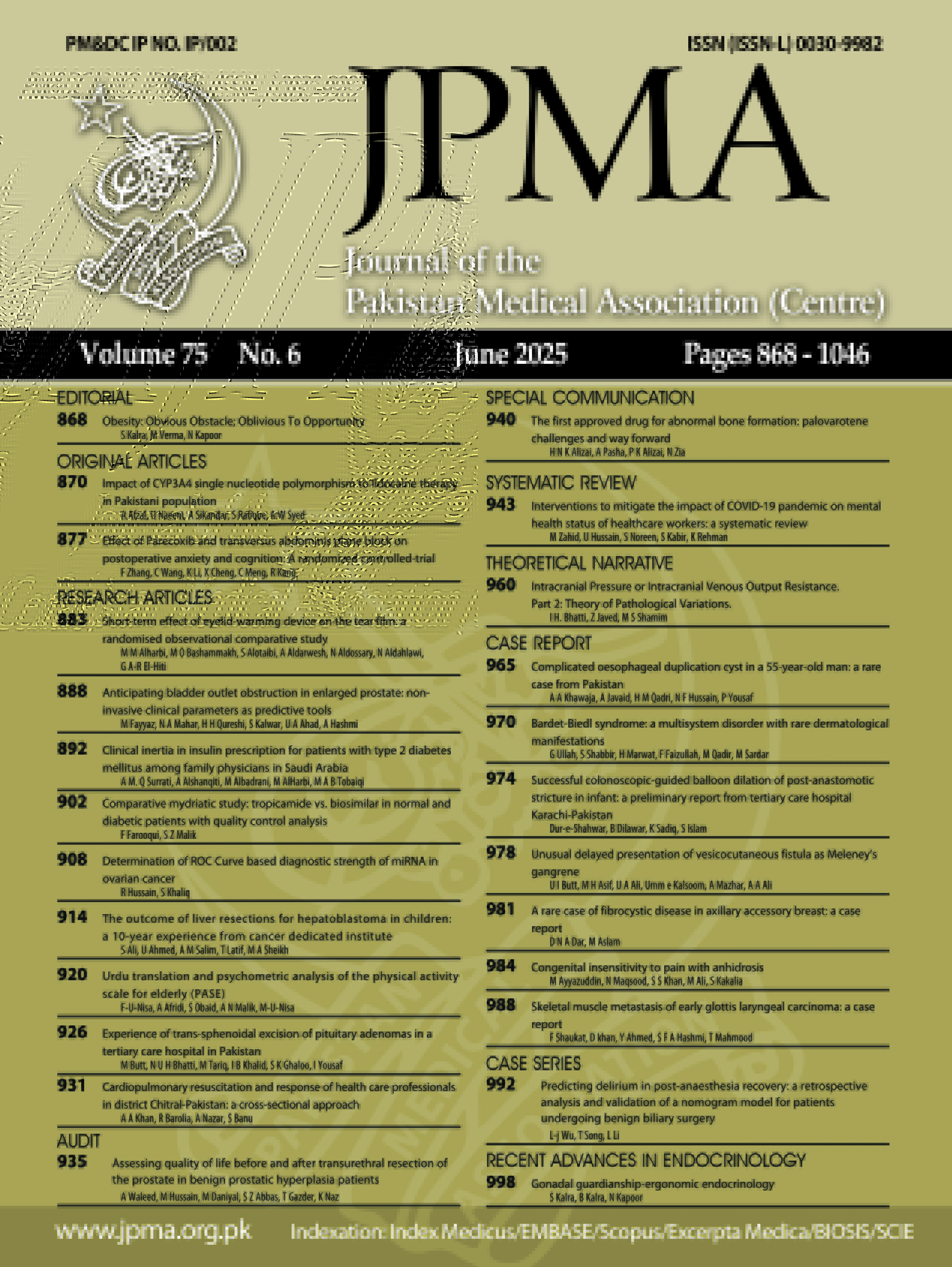
Intracranial Pressure or Intracranial Venous Output Resistance. Part 2: Theory of Pathological Variations.
DOI:
https://doi.org/10.47391/JPMA.25-43Abstract
An intracranial space-occupying lesion (SOL) has onlyweight and volume, and does not generate a pressure directly because of its presence or growth. It evolves in the incompressible tissue environment by displacing,parallel with its growth, an equal volume of one or more intracranial contents ‘extracranially’, directly or indirectly,into the dural venous sinuses. The three displaceable intracranial contents are brain tissue fluid, CSF, and bloodin the bridging veins and have different rates and resistances to extracranial output. Brain tissue fluid has the slowest rate but the lowest resistance to output. AnSOL must grow by displacing the lowest resistance content if its rate of growth is less or equal to the rate of output of brain tissue fluid. Only a very slow growinglesion such as an osteoma or a meningioma evolves by displacing brain tissue fluid. Intracranial venous flow resistance (VFR) and intracranial venous output resistance(VOR), or dynamic ICP (DICP), remain unaffected. Faster-growing SOL displaces CSF parallel with its growth. Again, VFR and VOR do not rise. An acutely expanding SOL suchas a parenchymal haematoma, subarachnoidhaemorrhage or acute hydrocephalus can evolve only by displacing venous blood, which has the fastest outputrate but the highest output resistance. Consequent narrowing of cortical veins elevates VFR and VOR (DICP).VOR elevates also if SOL obstructs dural venous sinuses.An SOL causes brain herniation by depleting one or more of displaceable intracranial contents across the midline ora foramen but elevates VOR only if there is cortical venous blood depletion with elevation of VFR. Intracranial haemorrhage displaces an equal volume of intracranial venous blood reducing intracranial arterial input, Theruptured vessel or aneurysm stops bleeding not because of a rise in ICP, which in keeping with Pascal’s Law isuniform in all intracranial contents, but because of are duction or cessation of input of blood to the arterialbed. All neurological signs are the result of regional orglobal ischaemia and have nothing to do with intracranial pressure.
Keywords: Intracranial Venous Flow Resistance,Intracranial Venous Output Resistance, Dynamic Intracranial Pressure, Bridging Veins, Cortical Veins,Intracranial Arterial Blood Pressure (IABP), Brain Herniation.
Downloads
Published
How to Cite
Issue
Section
License
Copyright (c) 2025 Journal of the Pakistan Medical Association

This work is licensed under a Creative Commons Attribution 4.0 International License.


